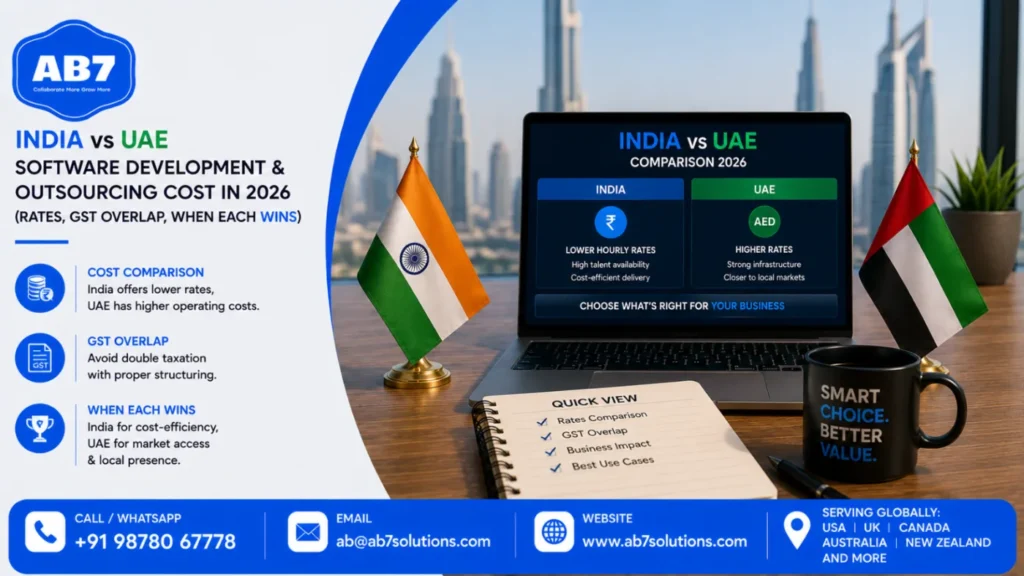
India vs UAE software development & outsourcing cost in 2026 (rates, GST overlap, when each wins)
India vs UAE for software, BPO and back-office delivery in 2026 is an unusual comparison, because the UAE is rarely a lower-cost alternative to India — it is one of the higher-cost hiring markets in the world, with a small, expat-dependent talent pool. The decision most Dubai and Abu Dhabi buyers actually face is not “India or the UAE” but “hire locally in the UAE, or deliver the same work through India.” On rate, a UAE-local software developer runs roughly $50–$90/hour and a local BPO agent $18–$30/hour, against India’s $18–$45/hour and $6–$14/agent-hour — so India lands 60–80% lower for comparable seniority. The variable that keeps this from being a clean sweep is not cost or scale, where India leads decisively, but two things the UAE genuinely owns: Arabic-language work and physical, on-the-ground presence inside the Emirates. The time-zone question that usually complicates offshore decisions barely applies here — India sits just 1.5 hours ahead of Gulf Standard Time, so a Mohali team and a Dubai client work essentially the same hours. A dedicated India engineer through AB7 starts from $1,500/month per FTE on GST-aligned shifts, run from its Mohali Phase 8B hub. The rest of this post breaks the decision down lever by lever, with the UAE’s genuine strengths named first.
The live stack list and engagement tiers sit on the AB7 Digital & Development Services page and the AB7 pricing page. The side-by-side rate, overlap and talent-depth table lives on the India vs UAE comparison page.
Where the UAE genuinely wins
Three real strengths, and none of them is cost. First, Arabic-language work: anything client-facing in Arabic — bilingual customer support, Arabic content and localisation, government-facing documentation, regulated communications in the local language — is far easier to staff from inside the Emirates than from an offshore pool where Arabic fluency is thin. Second, on-the-ground presence: roles that need a body in a Dubai or Abu Dhabi office — a relationship manager who meets clients in DIFC, a compliance officer who walks documents through a free-zone authority, an account lead who attends GITEX in person — cannot be delivered remotely, and a UAE local hire is the right answer. Third, regulatory proximity: work governed by DIFC Data Protection Law, ADGM regulation, or sector-specific Central Bank rules sometimes benefits from a team physically subject to those frameworks. The case for India below is about cost, scale and engineering depth for the large share of work that does not require Arabic fluency or a physical Emirates presence — not a claim that UAE hiring is wrong where those needs are real.
Where India wins
India’s edge for UAE buyers is cost, scale, engineering depth, discipline breadth and a time zone that removes the usual offshore friction. On cost, India runs 60–80% below a UAE-local hire — $18–$45/hour on software against $50–$90, and $6–$14/agent-hour on BPO against $18–$30 — and that gap compounds hard across a multi-month build or a standing back-office team. On scale, India’s developer pool of over five million engineers dwarfs the UAE’s small, expat-dependent market, so a five-person pod can grow into a fifteen-person programme without the local salary war that scarcity triggers in the Gulf; the UAE market often simply cannot staff the next ten engineers at any reasonable rate. On engineering depth, India carries a deep cybersecurity and AI bench alongside its developers — ISO 27001, SOC 2, VAPT, SOC analysts, data annotation, ML ops — so a security or AI-data specialist joins the same pod without a second vendor. On time zone, the 1.5-hour gap ahead of GST means near-real-time collaboration: a Mohali team shares almost the entire Gulf working day with a Dubai client, with daily standups in the same hours. On continuity, AB7 has held 90% client retention since 2015 by keeping the same pod on an account, so a React, Next.js, Flutter or Python team stays productive rather than churning through the UAE’s high-turnover expat labour market.
Cost, side by side
| Dimension | India (AB7 positioning) | UAE (local hire, indicative 2026) |
|---|---|---|
| Software developer rate (hr) | $18–$45 | $50–$90 |
| BPO agent rate (hr) | $6–$14 | $18–$30 |
| Dedicated mid-level engineer (mo) | from $1,500/month | indicative $9,000–$16,000/month |
| Small product pod (mo) | from $4,500/month | indicative $30,000–$55,000/month |
| Fixed-scope project | $2,000–$25,000 | varies by vendor |
| Cost vs UAE local hire | 60–80% lower | baseline |
| Time-zone gap | 1.5h ahead of GST (near-real-time) | same (GST) |
| Talent pool size | Very large — 5M+ developers | Small, expat-dependent |
| Arabic-language work | Limited | Strong |
| On-the-ground presence | Remote / offshore | Local |
India figures are AB7’s rate card; UAE numbers are indicative 2026 local-hire ranges, not quotes. Read the table as a split, not a tie: the UAE buys Arabic capability and physical presence at three to five times the rate; India buys a far lower cost, much greater scale, broad discipline coverage and a lower total bill, with the time-zone friction that usually penalises offshore work almost entirely absent at a 1.5-hour gap.
The time-zone question barely applies
Most India-versus-elsewhere decisions hinge on overlap with the client’s working day. For a UAE buyer, that question nearly disappears. India is only 1.5 hours ahead of Gulf Standard Time, so a Mohali or Bengaluru team starts its day a little before a Dubai or Abu Dhabi office and runs in parallel through almost the entire Gulf business day — no night shift to staff, no asynchronous handoff on time-critical work, no four-hour overlap window to ration. AB7 aligns named shifts to UAE core hours with daily standups, so a Dubai product owner gets the same live, same-day collaboration they would expect from a team two floors down, at a fraction of the cost. This is the quiet reason the India-to-UAE corridor works so smoothly: the single biggest objection to offshore delivery — “they’re asleep when we’re working” — is simply not true between India and the Gulf.
Communication, quality, and process
Quality is a function of process, not postcode. Ask how a feature reaches production: a real answer names pull-request review, CI on every commit, and a QA pass before merge. AB7 builds on GitHub with CI gates and a named tech lead per project, so a 10-week build shows a visible commit trend by week two rather than a surprise at delivery. The near-shared time zone makes this tighter still — a Dubai stakeholder can join a live standup, see the board move, and clear a blocker the same morning rather than waiting a day for an offshore reply. AB7 runs delivery in English as the primary business language with daily written status and direct stakeholder communication, and where a UAE engagement needs Arabic at the client-facing edge, the right pattern is a hybrid: a small UAE local team for the Arabic and on-the-ground roles, with the engineering, BPO and security volume delivered from India. For a firm moving an existing local build to India, a parallel-pod transition over two to four weeks keeps the incumbent team running while the AB7 pod ramps on the same repository — continuity without a cliff-edge handover.
Compliance and data residency
Data-protection questions decide many Gulf outsourcing contracts, so name the frameworks. The UAE runs a federal Personal Data Protection Law alongside the DIFC Data Protection Law and ADGM’s own regime; India runs the Digital Personal Data Protection Act 2023. Cross-border delivery is handled contractually — data-processing agreements, Standard Contractual Clauses, and India-side controls mapped to ISO 27001, SOC 2 and the client’s residency requirements. AB7 supports HIPAA, GDPR-aligned, DPDP-aligned and SOC 2 controls, so a Dubai fintech, an Abu Dhabi healthcare group or a Sharjah logistics operator can keep regulated or Arabic client-facing functions inside the Emirates while moving the engineering and back-office volume to a contractually compliant India pod. Where the work is genuinely residency-locked to the UAE, that work stays local; where it is not — which is most software, BPO and back-office volume — India delivers it at 60–80% lower cost.
The hidden costs nobody quotes
The headline rate is the smallest part of the real cost, and in the UAE the gap between rate and total cost is unusually wide. Three factors matter more than the hourly figure. First, scaling headroom: the UAE’s small, expat-dependent market means longer hiring cycles, visa overhead, and a local salary war when scarce skills are in demand, so a programme that needs to double its team pays for the scarcity; India’s deep bench backfills a leaver and adds headcount without a gap. Second, turnover: the Gulf’s expat labour market churns hard as workers move between employers and emirates, and each departure resets onboarding — AB7’s 90% retention since 2015 keeps the same pod on an account, so a React, Next.js, Flutter or Python team is productive in days, not re-hired every quarter. Third, the all-in employment load: a UAE local hire carries housing allowances, visa sponsorship, and end-of-service costs on top of salary, while an India delivery pod is a single monthly figure from $1,500/month per FTE. Cost the work by shipped output and by scaling, turnover and employment overhead — not by the rate card alone — and for everything that does not require Arabic or a physical Emirates presence, India is the lower total cost by a wide margin.
Which to pick when
Hire locally in the UAE when the role needs Arabic-language fluency at the client-facing edge, when it requires a physical presence in a Dubai or Abu Dhabi office, when regulatory residency is genuinely locked to the Emirates, or when in-person relationship management and on-the-ground compliance are the job itself. Deliver through India when cost and scale lead the decision, when the work is software, BPO, cybersecurity, AI or back-office volume that does not need Arabic or a local body, when you need headroom to scale a pod into a programme the UAE market cannot staff, and when you want a partner whose 1.5-hour time-zone gap makes the collaboration feel local. For most UAE buyers the highest-value answer is a hybrid — a small local team for the Arabic and presence-bound roles, and an India delivery pod for the engineering and back-office work at 60–80% lower cost. The full rate-by-rate breakdown sits on the India vs UAE comparison page.
Get a fixed number for your build
Send AB7 your stack, scope, and deadline, and AB7 will price a dedicated engineer or pod against your current UAE cost — seniority, GST-aligned overlap hours, named tech lead in writing, from $1,500/month. See the AB7 Digital & Development Services page and the pricing page, then call +1-321-341-7733, email director@ab7solutions.com, or book a 30-minute call with Ashok.